Jumat, 11 Desember 2009

Cultural adoption and adaptation from the Arab world

Some of the cultural constraints of working in the Arab world are a mystery to most and a source of endless frustration to many people working there  within the confines of international HQ'd company processes. Western values aren't adopted and accepted everywhere, and nor should they be, but that's often forgotten when global synergies in ad creative are being chased. Cultural differences are essential to what a friend of mine used to describe as life's rich carpet bag. Accepting and respecting these differences is important, as is taking time to understand how different influences across cultures, languages and borders blend together to create new interpretations, which is why I thought I'd share this TED talk on Arab Pop Culture with you:


I sat in a meeting this morning where someone reminded everyone that the accepted business models of now are based primarily on accepted developed world practices and yet the business growth of the future is going to come from India, China, Russia and other markets that are vastly different in size, scale and dynamics to the ones the current models are based on. 

Change is inevitable and those that can embrace it and adapt to it will be the winners.  As we approach the end of this decade, one thing I am sure about is that the world is going to be a very different place in ten years time as technology marches ever forward changing our lives in ways most of can't even imagine yet.

Rabu, 09 Desember 2009

Technology is something that didn't exist when you were born. A 9 year olds view of the world

I just came across this great video interviewing some (US) 9 year olds.

They've never heard of Napster and haven't a clue what "dial up" means / don't associate the sounds with the things I do.  They have mobile phones, and have been using iPods, PSPs and computers since they had the motor skills to move a mouse.  They have pocket money, listen to /download music, video and images, play games.  In short, are you doing enough to engage with the consumers of the future?

(Skip the 1st 50 seconds of introductions if you are short of time,  and the digital specific stuff starts at 1m28 ish))


The decade according to 9-year-olds from allison louie-garcia on Vimeo.

What does your digital morning look like?

I was pondering this morning on the role of digital connectivity in our lives.

I'm digital through and through, with an endless thirst for innovation and new experiences, yet I still force myself to have (at least one) "digital day off" a week (well almost entirely anyway, I am a big believer in the "mobile internet OFF" button on my phone).

Always on connectivity has many uses and advantages but it's important to remember
a) that however digitally reliant we are becoming, offline media play a role too
b) it's healthy (literally both physically and emotionally) to retain perspective by not being always connected to a device (I first had a BlackBerry in 2002 and gave it up deliberately in 2006 & have coped perfectly well without permanent attachment to an email box ever since, albeit have now got a smartphone/device or two so occasionally give in but as an exception rather than the rule)).  That said I'm unusual, mobile (web) usage peaks between 7 and 10am, when pc/mac based surfing takes over to reflect people's morning routines.

So assuming it's a weekday and I'm in the office my media / digital morning routine looks like this:
1) Radio alarm wakes me up & then I head to the kitchen turning on the (digital) radio (mostly for news / travel alerts) and then the kettle
2) Read snippets from "The Week" magazine whilst eating my cereal
3) Turn on mobile on train in the morning (I am fortunate enough to have lots of friends scattered all around the world and as a legacy of days when I travelled around the globe constantly I generally turn my phone(s) off at night, so I don't get woken up by messages buzzing in). Might respond to any texts I've missed. Too early to call many people.
4) Read London freesheet The Metro / a book
5) Might check in with FourSquare if I stop for coffee on my way to the office (more on that another time, but just started to play with it)
6) Turn my laptop on

At which point my digital day really starts properly.  I need the space to think first thing, which is why I prefer to read the paper / a book / stare out the window / often walk through Hyde Park to the office rather than immediately start processing information, tweets etc etc

So once in the office, first off I open Spotify, then Lotus Notes (urgh), then Tweetdeck, and then Firefox (usually already full of tabs of things I've been reading / working on).

Whilst Lotus Notes is doing it's (slow) thing, I'll scan Tweetdeck for interesting tweets from my Twitterati buddies, often providing links to my morning digital food for thought, so onward to Firefox.

Normally I'll open my mail boxes, read / action important mail /news alerts, and scan Facebook quickly before going back to read any links I've opened via Tweets. I also habitually go and check the picture of the day on Bing. It makes me happy .Then I dip briefly into Artwiculate to get the grey matter going.

Every few days I'll also dip into my RSS feeder and scan some blog posts.  Increasingly I use Twitter for tech updates and news and RSS feeds to carefully chosen blogs I like to follow / read more detailed posts than tweets allow.

And all that before 10am (ish) usually.


What does your digital morning look like?

Selasa, 08 Desember 2009

Got your Google Goggles yet?

We know that Google are going to be busy announcing all sorts of things this week and so far I've seen real time search going live  (so now I have Tweets relating to my query) appearing in my search results:


Then, going back to my point yesterday about everything getting more and more mobile, they're also launching Google Goggles, an augmented reality / visual search app for Android powered phones. (Not to be confused with Google Goggles in Gmail which makes you do maths questions to stop you sending emails you'll regret when you've sobered up!)

Shame Google Goggles doesn't seem to be enabled for the UK yet, so I can't tell you what I think about it in reality, as I can't find it in the Android store. :-(    In principle it will let me use the camera on my Android powered phone to find things relating to the content of the pictures I take.  (I also heard Snaptell ( a visual search engine that's been around for a while now) got snapped up by Amazon. Smart.)

Theme of the week in Google videos seems to be having two engineers presenting every new development (is this a rip off of the Mac v PC idea form Apple?!). At least this one's animated to make a change.

Senin, 07 Desember 2009

Increased relevancy in search: Good or Bad?

Buzzing around the web at the mo is lots of debate about Google's decision to roll out "opt out" search personlisation.

To the average consumer that means that they will now / soon have to consciously act to stop Google storing data about their search behaviour. If you have a Google account that means actively opting out of Google storing your web history indefinitely, and if you don't / are not signed in it means you need to choose to block Google's ability to store your search data via cookie for 180 days.  Then again, you might not want to block them out so you can benefit from increased relevancy in the way your search results are displayed. Your call.

Here's a rather geeky video Google posted on their blog to explain the benefits / opt out methods.


Do you feel this is Google being "Big Brother" ish or see the benefit of prioritised search results?

It's an interesting debate, and certainly one that will rage for a while.  I flip between both sides of the fence. I'm obviously interested in how search is evolving, and so trying to ignore quite how much Google know about me, I signed up to the Google Labs Social Search beta a while back...


I can see why daata privacy is a big hairy issue for a lot of people, but I also suspect that it's a bit like when people first started getting mobile phones - it took a while before people got over the issue of trusting a person's mobile number.

I remember lots of people being wary of calling a tradesman who only appeared to have a mobile number, rather than a landline, despite the fact that obviously if you've got a leaking tap, you really wanted to speak to the plumber himself ASAP not wait 'til he got home from work to pick up his messages.  I am sure we'll adapt fairly readily to sharing certain aspects of our digital behaviour if we can see the benefit to our busy lives of having results pre-filtered against either our social graph (friends/contacts), our previous/regular behaviour or, increasingly, our location as we move more and more interchangeably between desktop and mobile searches.

I can't see our lives getting any less busy, so I believe that shortcuts will become more and more important to us, whatever forms they may take. Where that gets interesting as a notion is therefore how brands will be able to play in that space. It means they will have to work hard to build relationships with us, and / or with our friends as the conduits to other people.  Interrupting people via search will get more and more challenging.

To me, the opportunity to initiate those relationships by being useful or entertaining is now. At the moment there's lots of people exploring and open to try new things. True, there will always be some that continue to do so, but I also think that humans being humans, we'll also quickly find that people find a repertoire of "service providers" for certain things and then it will become much harder to get them to swap and try something else unless the current provider fails to deliver. It makes total sense.  We already know that most people have around 8 favourite / default TV channels from the many to choose from, 6-8 websites they visit regularly, so getting your brand on that trusted repertoire list ASAP, whether it's for "go to" stuff or stuff coming to you via an app/RSS/Twitter feed etc is pretty important.

I predict a war of attrition starting in the next 12-18 months with brands fighting each other hard for deeper relationships with the relatively small numbers of wavering consumers. At the minute the field is open, so think about how you can start being useful or relevant to your consumers to start building brand affinity / sign up to apps / services that go beyond just flogging brand benefits to death.  There'll always be a role of traditional offline media like TV for that!

Rabu, 02 Desember 2009

Twittle

A new Twitter client app has hit the app store!

Called twittle, it's a basic yet very functional Twitter app.

The first thing that caught my attention was how quick it was at loading the app and all the posts, even on a GPRS connection..


Priced at 59p, it's cheaper than most of the Twitter apps that are any good.


It comes with 2 themes; dark and light. I personally prefer the dark theme.


My favourite feature is the settings option to use safari as the broswer instead of the built in one as they tend to be less functional.

Pros: it's lightning quick, retweets work well (which is more than can be said for tweetie right now), the 2 different themes.

The cons: it will not allow you to click links in tweets which kind of takes away the auto open safari feature, if you try to do too much at once it crashes, it doesn't like loading user profiles..

Summary: it's very good for a beginner.. But for an extensive Twitter user it doesn't pull out the stops.

A few updates will fix that.. Especially if they add a lists feature..

For now I'm sticking with tweetie, but don't rule this one out until you've tried it :)

iBlog marks: 3/5


Selasa, 01 Desember 2009

When is TV not TV? When it's on YouTube. Or is it?

It's tricky one isn't it? We used to say "what's on the box?" meaning the TV, but now we all have flat screens or panels, so that no longer really rings true.   Yet "TV" is a term that we generally associate with long form multi-media content that isn't feature-film length but is longer than the traditional 3 minutes of content snacking we're used to on YouTube.

As broadcasters come to terms with the notion of on-demand TV content, they're increasingly seeing YouTube & it's brethren (Hulu, dailymotion,etc) as powerful platforms to extend the reach of their shows.  Channel 4 announced last week  that 50 hours/week of catch-up TV content will be available on YouTube (as well as 4 on demand), along with a joint ad revenue sharing deal.

So TV is now just a generic term for longer than short form but not as long as feature film multi-media content, that has it's origins (be they a commission, acquisition or initial exposure) via the hallowed halls of a broadcaster.

Which is as it should be from a consumer persepctive: content should be platform agnostic.

As a consumer I want to watch what I want to watch, when I want to watch it and whichever screen is most convenient at the time.  All of which then raises a whole heap of other questions about how you create those "water cooler" discussion moments of shared experience driven by people you know watching the same thing at the same time.

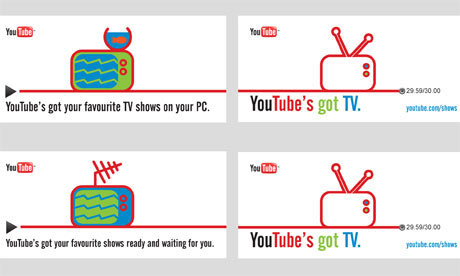
So with that in mind, and remembering however digitally savvy we all are, we don't just live in cyberspace, I bring youYouTube's first venture into offline advertising: